Useful Resources for Your Greek Island Trip
- Find accommodation in Greece – hotels, apartments and villas on Booking.com
- Book tours and activities in Greece via Viator
- Find guided experiences and day trips via GetYourGuide
- Compare car hire prices in Greece via DiscoverCars
The Ionian Islands are a chain of seven main islands off the west coast of Greece, stretching from Corfu in the north to Kythira in the south.
Unlike the better-known Cyclades in the Aegean, the Ionian Islands sit in the Ionian Sea and have a distinct character shaped by Venetian rule, lush green landscapes, and a wetter climate. They are among Greece’s most popular destinations, with Corfu and Zakynthos drawing the largest crowds, while smaller islands like Paxos and Ithaca remain quieter alternatives.
Where Are the Ionian Islands?
The Ionian Islands lie along the western coast of Greece, in the Ionian Sea. They form a loose north-south chain running from the Albanian border in the north to just south of the Peloponnese. The seven main islands are:
- Corfu (Kerkyra) — the northernmost and most visited
- Paxos (Paxi) — small and quiet, just south of Corfu
- Lefkada — connected to the mainland by a causeway
- Kefalonia (Cephalonia) — the largest of the seven
- Ithaca (Ithaki) — small, legendary home of Odysseus
- Zakynthos (Zante) — known for its beaches and sea turtles
- Kythira — the southernmost, geographically closer to the Peloponnese
The islands are not clustered together. Corfu is roughly 350 km from Kythira by sea, which matters when planning ferry connections. The Ionian Sea islands are greener and hillier than most Aegean islands, with more rainfall and cooler summers in the north.
Best Ionian Islands to Visit
Each island in the Ionian group has a different character. Which is the best Ionian island to visit depends entirely on what you want from a trip — nightlife and beaches, hiking and scenery, or genuine quiet.
Corfu
Corfu is the most developed and most visited of the Ionian islands. The old town (Corfu Town) is a UNESCO World Heritage Site, with Venetian architecture, narrow lanes, and two Venetian fortresses. The north of the island has the busiest beach resorts; the south and interior are quieter. Corfu has its own international airport and multiple ferry connections, making it the easiest island to reach.
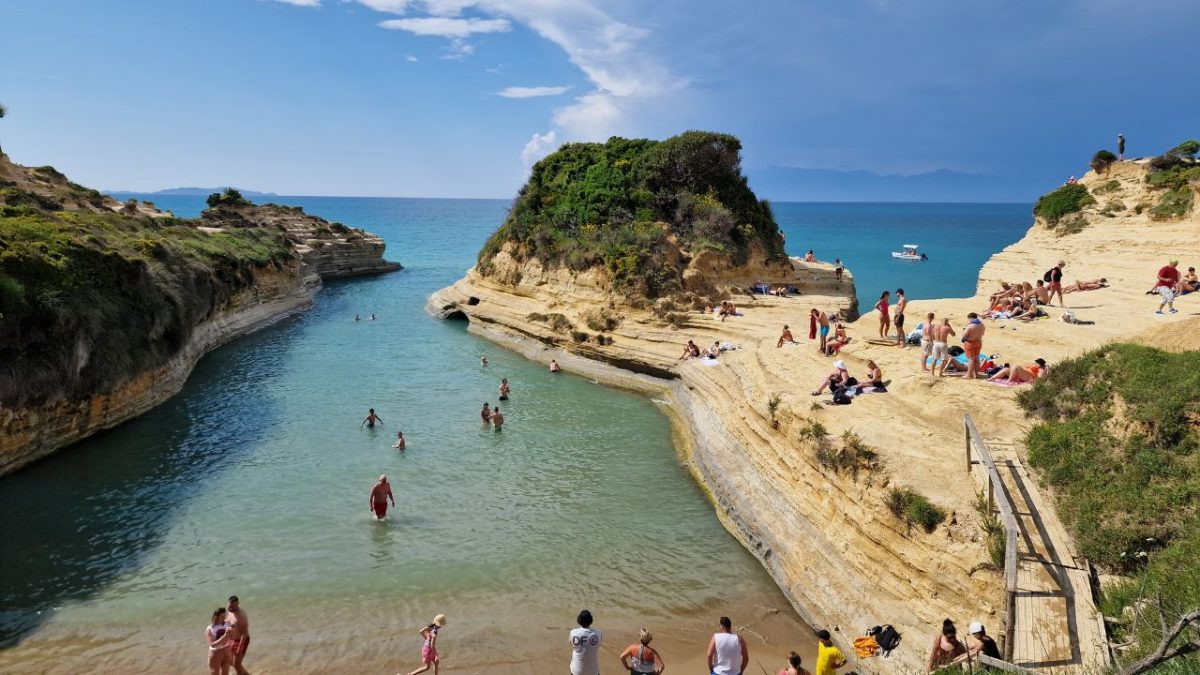
For more detail on where to stay, what to see, and how to get around, see the Corfu travel guide.
Zakynthos (Zante)
Zakynthos draws visitors with Navagio Beach (Shipwreck Beach) — one of the most photographed beaches in Greece — and the Blue Caves on the north coast. The island also has a significant loggerhead sea turtle nesting population in Laganas Bay, with protected zones in effect during summer. The eastern coast has the bulk of the tourist infrastructure; the west coast is more rugged and scenic.
Kefalonia
Kefalonia is the largest Ionian island and feels less overrun than Corfu or Zakynthos. Myrtos Beach is widely cited as one of the best beaches in the Ionian Islands — steep cliffs, vivid blue water. The island has its own airport (Argostoli), good road connections internally, and a variety of landscapes from forested mountains to coastal villages. Fiskardo in the north is the most picturesque village, popular with yacht traffic.
Lefkada
Lefkada is connected to the Greek mainland by a floating bridge and causeway, which means you can drive there without a ferry. Porto Katsiki and Egremni on the west coast are among the best beaches in the Ionian Islands — high white cliffs dropping to turquoise water. Lefkada Town itself was heavily damaged by earthquakes in the 20th century and rebuilt in a distinctive style. The island is popular with windsurfers, particularly around Vassiliki in the south.
Ithaca
Ithaca is small, quiet, and best suited to those who want to slow down. It has no airport and limited beach options, but the scenery is attractive and the island has strong historical associations as the legendary home of Odysseus. The main town, Vathy, sits at the head of a deep bay and has a genuinely unhurried atmosphere. Most visitors come for a day trip from Kefalonia, but staying overnight gives a different experience.
Paxos and Antipaxos
Paxos is the smallest of the main Ionian islands and one of the most charming. Gaios is the main village; Lakka and Longos are smaller and quieter. The island is mostly covered in olive groves and has no airport. Antipaxos, just to the south, has two exceptional beaches — Voutoumi and Vrika — with water that rivals the Caribbean for colour. Both islands are best visited as a slow destination rather than a quick stop. For getting there, see the guide on how to get to Paxos.
Ionian Islands Ferry Connections
Ferry connections in the Ionian Islands work differently from the Cyclades. The islands are not a compact cluster — they’re spread over a long coastline — and direct inter-island ferry routes are limited. In most cases, travel between islands involves going back to a mainland port rather than island-hopping directly.
The main mainland departure points for the Ionian Islands are:
- Igoumenitsa — the main port for ferries to Corfu and Paxos. Fast ferries to Corfu take around 90 minutes; conventional ferries take longer. See the guide to Igoumenitsa ferry port for practical details on the port itself, and the Igoumenitsa to Corfu ferry page for that specific route.
- Patras — the main port for ferries to Kefalonia and Ithaca, and for international routes to Italy.
- Kilini — ferries to Zakynthos and Kefalonia (Poros port).
- Astakos — less-used port with connections to Ithaca and Kefalonia.
Corfu has two ferry ports: Corfu Town ferry port handles the majority of traffic including international ferries to Italy; Lefkimmi ferry port in the south of the island handles shorter crossings to Igoumenitsa and is useful if you’re staying in the southern part of Corfu.
For booking ferry tickets across Ionian routes, Ferryscanner covers the main routes and operators, letting you compare schedules and prices in one place.
Island Hopping in the Ionian Islands
Island hopping in the Ionian Islands is possible but requires more planning than the Cyclades. The islands don’t form a connected circuit with regular inter-island ferries. The practical approach is to build a route around mainland hubs or focus on the central cluster (Kefalonia, Ithaca, Lefkada) where connections are closer together.
1-week Ionian Islands itinerary: Fly into Corfu (2–3 nights), then travel down to Kefalonia via Igoumenitsa and Patras, or fly directly to Kefalonia if schedules allow (2 nights), with a day trip to Ithaca. End in Zakynthos (2 nights) with a flight home from there. This covers the three most accessible islands without excessive travel days.
2-week Ionian Islands itinerary: Fly into Corfu (3 nights), take the ferry to Paxos for a slow 2-night stop, return to Igoumenitsa and travel south to Lefkada (2 nights), then Kefalonia (3 nights) with a day trip or overnight to Ithaca, finishing with 3 nights on Zakynthos. This covers all the main islands and allows time to settle in rather than transit constantly.
Lefkada is the easiest island to add to an itinerary since it’s reachable by road from the mainland — no ferry needed. Kythira is geographically remote from the other six and works better as a standalone destination than part of a hopping route.
Best Time to Visit the Ionian Islands
The Ionian Islands have a Mediterranean climate with hot, dry summers and mild, wet winters. The peak tourist season runs from late June through August. During this period, Corfu and Zakynthos in particular are busy, prices are at their highest, and ferries should be booked in advance, especially if travelling with a vehicle.
The shoulder seasons — May to mid-June and September to October — are generally the best time to visit the Ionian Islands for most travellers. Temperatures are warm (typically 22–28°C), the sea is swimmable from May onwards, crowds are lower, and accommodation prices drop significantly. September is often considered the sweet spot: the sea is at its warmest (around 24–25°C), summer crowds have thinned, and the landscape is still dry and golden.
April and early May are greener and cooler — good for hiking and sightseeing, less suited to beach holidays. The Ionian Islands are notably greener than the Cyclades because they receive more rainfall, particularly in winter and spring. November through March is quiet across all islands, with many tourist businesses closed.
How to Get to the Ionian Islands
The main routes into the Ionian Islands are by air and by ferry from mainland Greece.
By air: Corfu (CFU), Zakynthos (ZTH), and Kefalonia (EFL) all have international airports with direct charter and scheduled flights from major European cities during the summer season. Lefkada has no airport; the nearest is Preveza (PVK) on the mainland, about 20 km away. Ithaca and Paxos have no airports.
By ferry from the mainland: Most mainland ferry ports for the Ionian Islands are on the northwest or western coast of Greece. Igoumenitsa is the main gateway to Corfu and Paxos — the crossing from Igoumenitsa to Corfu is one of the most frequent short ferry routes in Greece. The Igoumenitsa ferry port also handles international routes to Italy. For Kefalonia, Ithaca, and Zakynthos, Patras and Kilini are the main departure ports.
By road to Lefkada: Lefkada is the only Ionian island reachable by road. The floating bridge connecting it to the mainland at Lefkada Town is open around the clock, making it straightforward to drive onto the island from the Preveza direction.
International ferries: If travelling overland through Italy, Corfu and Patras (for Kefalonia/Ithaca/Zakynthos) are both served by overnight international ferries from Ancona, Bari, Brindisi, and Venice. This is a practical option for travellers combining Italy and Greece in a single trip.
Ionian Islands FAQ
What are the 7 Ionian Islands?
The seven main Ionian Islands are Corfu, Zakynthos, Kefalonia, Lefkada, Ithaca, Paxos, and Kythira. There are also smaller uninhabited or sparsely populated islands in the group, such as Antipaxos, Meganisi, and Erikoussa, but these seven are the principal islands of the Ionian region.
Which is the best Ionian island to visit?
There is no single answer — it depends on what you want. Corfu has the most infrastructure, history, and variety. Zakynthos has the most dramatic beaches. Kefalonia is the best all-rounder for those wanting scenery, beaches, and fewer crowds than the top two. Paxos and Ithaca are best for travellers who specifically want to escape busy tourism. Lefkada is easiest to reach by road and has excellent beaches.
Can you island hop in the Ionian Islands?
Yes, but it requires planning. Direct inter-island ferry connections are limited compared to the Cyclades. The central cluster of Kefalonia, Ithaca, and Lefkada is the easiest area for island hopping. Corfu and Paxos connect well together via Igoumenitsa. Kythira sits apart from the rest and is best treated as a separate trip.
What is the best time to visit the Ionian Islands?
May–June and September–October are the best months for most travellers — warm enough for the beach, fewer crowds, lower prices. July and August are peak season: hottest, busiest, and most expensive. April is good for walking and sightseeing but cooler for swimming. Winter is quiet with many facilities closed.
How do you get to the Ionian Islands?
Corfu, Zakynthos, and Kefalonia have direct international flights. All islands except Lefkada require a ferry from the Greek mainland; Lefkada is accessible by road across a causeway. Key mainland ferry ports are Igoumenitsa (for Corfu and Paxos), Patras (for Kefalonia and Ithaca), and Kilini (for Zakynthos). International ferries from Italy also serve Corfu and Patras.
Are the Ionian Islands the same as the Greek islands?
The Ionian Islands are one group within the broader category of Greek islands. Greece has hundreds of inhabited islands spread across several distinct groups: the Cyclades, the Dodecanese, the Sporades, the Saronic Islands, the North Aegean islands, and the Ionian Islands. The Ionian Islands are the westernmost group, in the Ionian Sea, while most other Greek island groups are in the Aegean Sea to the east.