Useful Resources for Your Greek Island Trip
- Find accommodation in Greece – hotels, apartments and villas on Booking.com
- Book tours and activities in Greece via Viator
- Find guided experiences and day trips via GetYourGuide
- Compare car hire prices in Greece via DiscoverCars
The currency in Crete is the Euro (EUR). Whether you are visiting Heraklion, Chania or other areas on the island, here’s what you need to know about money, ATMs and card usage.
Greece’s largest island, Crete draws visitors to its major cities — Heraklion, Chania, Rethymno, and Agios Nikolaos — as well as quieter inland villages and remote southern coastline. Wherever you’re heading on the island, you’ll be using Euros throughout your trip.
Using Euros in Crete
The Euro is the only official currency used in Crete, as it is across all of Greece. There is no separate regional currency — the Crete currency is straightforwardly the Euro, whether you’re dealing with money in Crete’s big cities or a small hilltop village in the interior.
Euro banknotes come in denominations of 5, 10, 20, 50, 100, 200, and 500 EUR, though larger notes are rarely used in everyday transactions and some businesses won’t accept them. Coins run from 1 cent to 2 EUR. If you’re coming from outside the Eurozone, you’ll need to either bring euros from home or get them on arrival.
Cash vs Cards in Crete
Cards are widely accepted in the main tourist areas of Heraklion, Chania, and Rethymno. Most hotels, restaurants, and larger shops in these cities will take Visa and Mastercard without any issue. American Express is accepted in some places but far less commonly — don’t rely on it.
That said, cash still matters in Crete more than in some other European destinations. A few situations where you’ll want it:
- KTEL intercity buses typically require cash payment. If you’re travelling between cities by bus, carry coins and small notes.
- Remote villages and mountain areas — especially in the White Mountains (Lefka Ori) region or the less-visited southern coast — often have limited or no card acceptance. Small family-run tavernas and rooms-to-let operations frequently prefer cash.
- Some beach sunbed operators and smaller kiosks are cash-only.
- Markets and roadside stalls are almost always cash.
As a general rule: the further you get from the main tourist centres, the more you should rely on cash. Keeping 50-100 EUR in notes at any given time is a reasonable buffer for most travellers.
ATMs and Banks in Crete
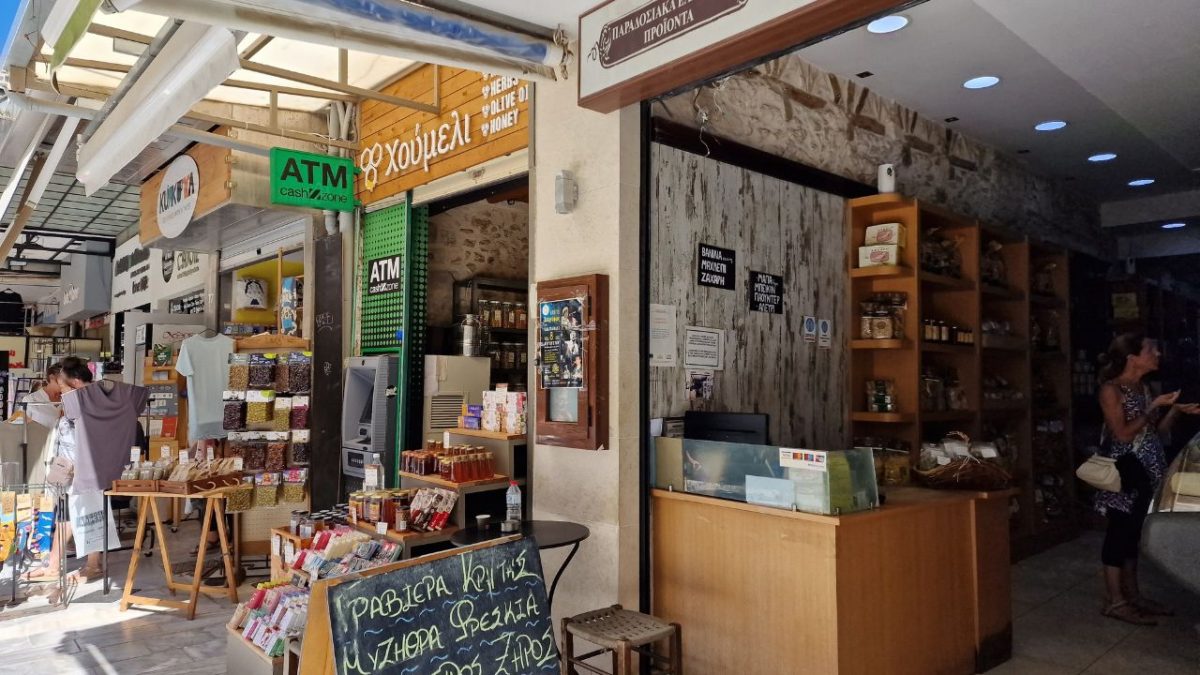
ATMs are easy to find in Crete’s main cities and tourist areas. In Heraklion, you’ll find multiple ATMs near Lions Square (Plateia Eleftherias), along 25th Avgoustou Street, and around the port area. In Chania, the area around the Venetian harbour has several ATMs within easy walking distance. Rethymno and Agios Nikolaos also have a reasonable number of machines in their centres.
The picture changes once you move away from these hubs. Smaller villages, particularly along the remote southern coast and in the mountain interior, may have one ATM or none at all. If you’re planning to spend time in less-visited areas, withdraw enough cash before you leave the main towns.
Most ATMs are operated by major Greek banks: National Bank of Greece, Alpha Bank, Eurobank, and Piraeus Bank. Foreign card fees typically run 2.50-3.00 EUR per withdrawal plus any charge from your own bank, so withdraw larger amounts less often to keep costs down. If an ATM offers to convert the amount to your home currency (Dynamic Currency Conversion), decline it — always choose to pay in euros.
Currency Exchange in Crete
If you need to do a money exchange in Crete, your best bets are Heraklion and Chania. For currency exchange, Crete’s main tourist cities have offices (bureaux de change) near the harbour, old town, and main shopping streets. In Chania, the old town around Halidon Street has several options; Heraklion currency exchange offices concentrate near the port and Eleftherias Square. You’ll also find exchange services at both airports.
The rates at exchange kiosks are rarely competitive. Banks offer better rates than street-level offices, but queues can be slow. The simplest approach is to arrive with euros already, or withdraw euros from ATMs using a card with no foreign transaction fees. For Crete money management overall, Wise and Revolut are worth considering — they let you spend at or near the interbank rate, which beats any money exchange Crete tourist areas can offer. For currency exchange Crete bank branches will give you better rates than street kiosks if you must use one.
Tips for Managing Money in Crete
- Arrive with some euros already on you — airport exchange rates are poor, and queues at Heraklion Nikos Kazantzakis Airport can be long on peak arrival days.
- Use ATMs in bank lobbies or attached to banks where possible; standalone ATMs in tourist areas sometimes charge higher fees.
- Always decline Dynamic Currency Conversion at ATMs and card terminals — pay in euros.
- Keep small change handy. Many smaller shops and tavernas struggle to break 50 EUR notes, especially earlier in the day.
- If travelling to the south coast (Matala, Loutro, Paleochora), withdraw cash in Heraklion or Chania before heading down — ATM availability drops sharply.
- Tipping is not mandatory in Crete but appreciated. Rounding up the bill or leaving a few coins is common practice at tavernas.
Money in Crete FAQ
What currency does Crete use?
Crete uses the Euro (EUR). Greece is part of the Eurozone, so the Euro is the official currency across the entire country, including Crete — there’s no separate island currency.
Can you pay by card in Crete?
Yes, in most tourist areas. Hotels, restaurants, and shops in Heraklion, Chania, and Rethymno generally accept Visa and Mastercard. Cash is still needed in smaller villages, on KTEL buses, and at many smaller local businesses — it’s worth carrying both.
What is the currency in Heraklion?
The currency in Heraklion is the Euro, the same as the rest of Crete and Greece. As Crete’s capital, Heraklion has plenty of ATMs, banks, and currency exchange offices — accessing euros there is straightforward.
What is the currency in Chania?
The Chania currency is the Euro, the same as the rest of Crete. Chania money matters are easy to handle — you’ll find ATMs and exchange offices around the Venetian harbour area and throughout the old town.
Are there ATMs in Crete?
Yes, ATMs are plentiful in Heraklion, Chania, Rethymno, and Agios Nikolaos. They become scarce in smaller villages and remote areas, so withdraw cash before heading off the beaten track. Foreign card fees are typically around 2.50-3.00 EUR per withdrawal.
Is it better to use cash or card in Crete?
A combination works best. Cards are convenient in the main cities and tourist areas, but cash is essential for buses, smaller tavernas, and anywhere away from the main tourist centres. Withdraw enough before leaving a major town and keep small denominations handy.
Related: Heraklion Ferry Port | Currency in Santorini | Currency in Rhodes | Currency in Corfu